
The Power of Taking Your Time in Building a Brand

Updated: Jul 17

There's a version of building a brand that looks like this: drop constantly, move fast, stay visible, repeat.
I understand the appeal. Momentum feels like progress. A full release calendar looks like a thriving business. In a market that rewards noise, slowing down can feel like falling behind.
But I've learned — sometimes the hard way — that speed in product development is usually borrowed time. You're not moving faster. You're just paying later.
What Rushing Actually Costs
The costs of rushing a product aren't always visible immediately. That's what makes them dangerous.
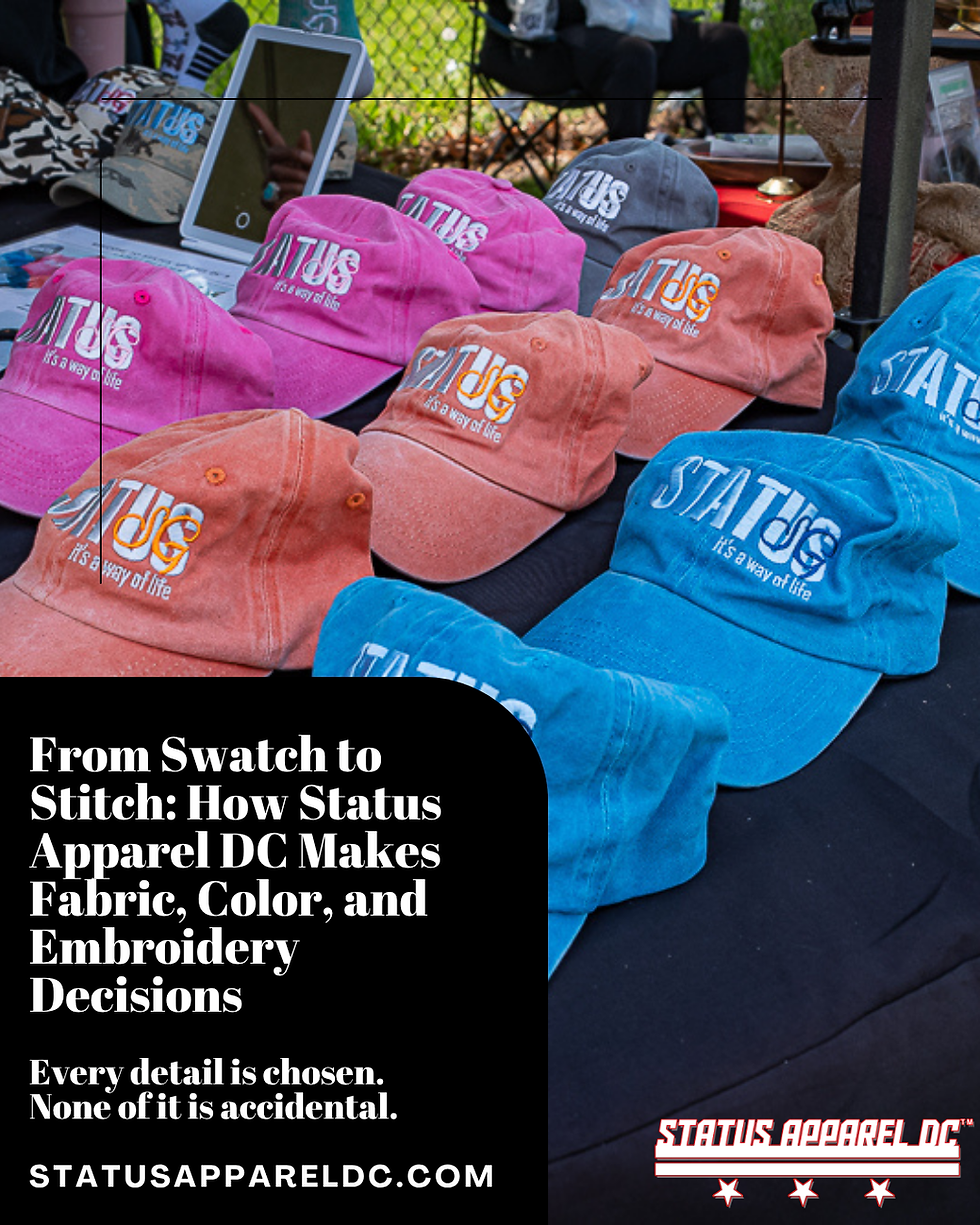
A sample that wasn't tested long enough ships with a fit problem you didn't catch. A colorway that looked right on screen reads differently on fabric in person. An embroidery spec that wasn't confirmed produces a graphic that loses definition after a few washes. None of these failures announce themselves until the product is already in a customer's hands.
At that point, the cost isn't just the product. It's the return. The customer service exchange. The replacement. The erosion of trust from someone who gave you a chance and got something that didn't meet the standard you implied.
That's the real math behind a rushed release. The short-term gain of getting something out fast rarely outweighs the long-term cost of getting it wrong.
What Slowing Down Actually Looks Like
Slowing down isn't the absence of work. It's a different kind of work — one that's harder to show and easier to skip when there's pressure to release.
At Status Apparel DC, slowing down looks like:
Running a sample through actual wear before approving it — not just a try-on.
Confirming embroidery placement on the physical garment, not just the digital mockup.
Sitting with a colorway long enough to see how it reads in different lighting conditions.
Revising measurements based on what the previous version revealed.
Waiting on a manufacturer relationship until the vetting process is actually complete.
Awaiting Cut-and-sew production (Note: Cut-and-sew represents the highest level of apparel craftsmanship, with each garment created from custom-cut fabric panels rather than pre-made blanks, resulting in distinctive style, premium quality, and lasting durability.)
None of these steps produce content. None of them show up in a release announcement. But every one of them is present in the finished product — felt by the customer even when they can't identify why it feels right.
The Compounding Value of Getting It Right
Here's what the slow approach builds that the fast approach can't:
A customer who receives a garment that fits exactly as expected, holds its shape after washing, and looks as good in person as it did online doesn't just come back. They bring someone with them.
That kind of trust doesn't come from a well-timed drop or a polished campaign. It comes from a product that quietly exceeds expectations — and does it consistently, not just once.
Consistency is only possible when the process behind it is disciplined. And discipline, by definition, takes more time than shortcuts.
The brands that have built something durable — the ones that still matter five and ten years in — aren't the ones that released the most. They're the ones that released things worth remembering.
What It Actually Costs to Slow Down
I want to be honest about this part because most people skip it.
Slowing down costs something real. It costs release dates you had in your head. It costs the momentum of a drop you were excited about. It costs the immediate revenue of a product you could have shipped two months earlier.
Those are real trade-offs. I'm not going to pretend otherwise.
But what I've found is that the cost of slowing down is almost always finite. A delayed release has a clear end point. A product that damaged customer trust has a repair process that's much harder to map — and much more expensive to complete.
The question isn't whether slowing down costs something. It's whether what you're building is worth protecting.
For Status Apparel DC, the answer has always been yes.
Why This Is a Business Decision, Not Just a Philosophy
I want to be clear that this isn't just an aesthetic preference or a founder's personal standard. It's a business decision with measurable downstream effects.
When a product meets the standard we set for it:
Return rates stay low.
Customer satisfaction drives repeat purchases.
Word of mouth works in our favor.
The brand's credibility compounds over time.
When a product doesn't meet that standard — regardless of why — every one of those outcomes reverses.
The business case for slowing down isn't abstract. It shows up in the numbers. It shows up in the inbox. It shows up in whether a customer who bought once becomes a customer who buys every time something new drops.
That's what taking your time actually saves.
Embracing the Journey
Building a brand is a journey. It's not just about the destination but also about the experiences along the way. Each piece we create tells a story. It reflects our values and the community we serve.
We take pride in our craftsmanship. Each stitch, each design choice, is intentional. We believe that clothing should be more than just fabric. It should carry meaning and purpose.
When we take the time to create thoughtfully, we invite our customers to be part of something bigger. They wear our pieces not just for style but for the message they convey.
A quick note from Gabriel: Every product in our catalog has gone through this process. Not every piece made it to release — and that's by design. If you ever wonder why we don't drop constantly, now you know.
Featured Products
FAQ Section
Q: Why does Status Apparel DC release products slowly?
A: Status Apparel DC prioritizes quality over volume. Every product is sample-tested, fit-reviewed, and production-verified before release — because a product that meets the standard once isn't enough; it has to meet it consistently.
Q: What makes Status Apparel DC different from other streetwear brands?
A: Status Apparel DC uses cut-and-sew manufacturing — meaning garments are built from raw fabric, not sourced from pre-made blanks. This allows for custom fit systems, embroidery precision, and quality standards that off-the-shelf production can't match.
Q: Is Status Apparel DC a Black-owned brand?
A: Yes. Status Apparel DC is a Black-owned lifestyle apparel brand founded and based in Washington DC, built around the belief that Status: It's a Way of Life. Designer Gabriel Massalley is the founder of Status Apparel DC
Q: What is the "Daily Motivation Series"?
A: The Daily Motivation Series is a core Status Apparel DC product line featuring apparel designed to carry meaning and positive messaging — a direct expression of the brand's community-driven identity.


Comments